Boats
Range is a speed problem: electric boat range explained
How far an electric boat goes depends on speed more than battery size. The physics, real figures from three boats and how to work out your own range.
9 October 2026 · 4 min read
Every kook thinks they need a bigger battery. They want to cross the ocean at thirty knots, then they see the price tag and the weight, and the stoke vanishes. We checked the physics, and it turns out that range is not a capacity problem. It is a speed problem.
The first question about any electric boat is how far it goes. The honest answer is another question: how fast do you want to travel? On the water, speed decides range far more than the size of the battery does.
The glassy math formula
When the water is glassy, the math is simple. Range comes from three numbers.
- Usable battery capacity, in kilowatt-hours (kWh).
- Power draw at your chosen speed, in kilowatts (kW).
- Speed, in knots.
Capacity divided by power draw gives hours. Hours multiplied by speed gives nautical miles.
6 kWh ÷ 1.5 kW = 4 hours. 4 hours × 4.3 knots = about 17 nautical miles.
That example is real. It comes from a 7.37-metre sailboat converted to a 3 kW electric pod drive with a 6 kWh battery.
Why speed is an onshore chop
A boat pushes water aside to move. The faster it goes, the more water it has to move per second, and the resistance climbs much faster than the speed. It is like trying to paddle through a heavy onshore chop: you work twice as hard for half the progress.
The same sailboat shows how steep the curve is. At 1.5 kW it reaches 4.3 knots, close to its hull speed. Doubling the power to 3 kW adds only 0.9 knots. Run the formula again for both cases.
| Power draw | Speed | Hours on 6 kWh | Range |
|---|---|---|---|
| 1.5 kW | 4.3 knots | 4.0 | about 17 nm |
| 3.0 kW | 5.2 knots | 2.0 | about 10 nm |
Going 21 percent faster costs 40 percent of the range. That trade is typical for a displacement hull near its top speed.
Three hulls in the line-up
How a hull behaves decides which part of the curve you live on.
Displacement hulls sit in the water at all speeds. Sailboats, launches and most canal boats are in this group. They are very efficient when slow and hit a wall near hull speed. They suit electric drive well, because a small motor and a modest battery go a long way at 4 to 6 knots.
Planing hulls rise onto the surface at speed. Getting over the hump takes a lot of power, and staying on the plane takes less than the hump but far more than displacement speed. A planing electric boat has a short range at speed and a long one when idling along. The awkward zone is in between, where the boat is ploughing: slow and thirsty at once.
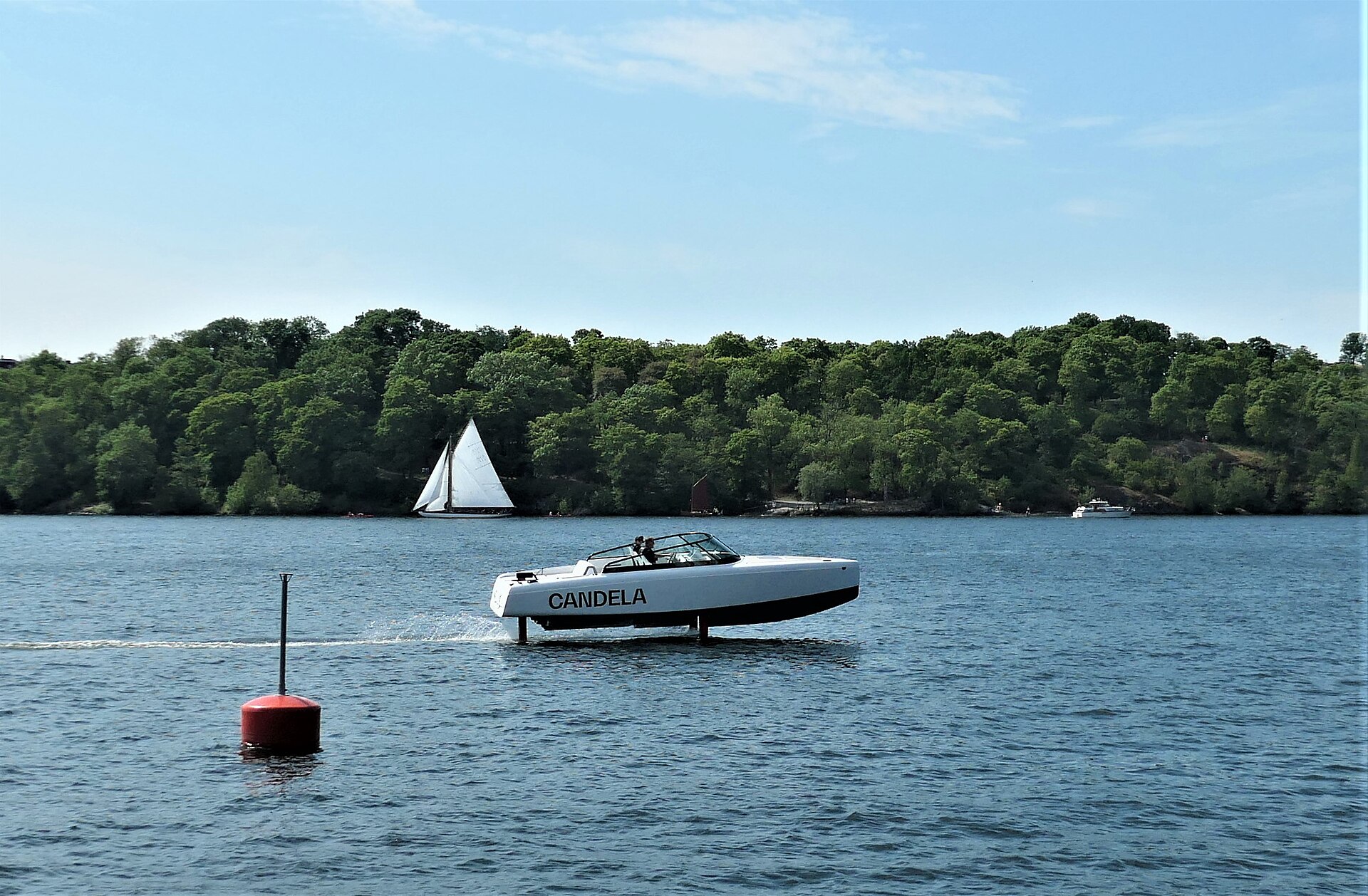
Foiling hulls lift clear of the water on wings. With the hull out of the water, resistance drops sharply. The Candela C-8, an 8.5-metre foiling day cruiser, was reported at launch to draw 16 kW at 22 knots. Its maker says foiling cuts energy use by 80 percent compared with a conventional boat of similar size. We look at this in Foiling electric boats.
The groundswell of big numbers
The later version of the C-8 carries a 69 kWh battery and is rated at up to 57 nautical miles at a cruising speed of 22 knots. That works out at about 1.2 kWh per nautical mile, and roughly two and a half hours of running.
If the maker's 80 percent figure holds, a conventional planing boat of the same size would use about five times as much energy per mile. This is why fast electric boats are a groundswell of innovation: they are either small and light, or they foil, or they carry very large batteries.
Range killers in the chop
Brochure figures are measured at one speed, in calm water, usually with a light load. These take range away.
- Wind and waves: a headwind can add a large share to the power needed at low speed.
- Current: speed over ground is what gets you home, not speed through water.
- Weight: extra passengers and gear matter most on planing and foiling boats.
- A fouled hull or propeller: growth adds drag all season.
- Cold: batteries deliver less at low temperatures.
- Other consumers: fridges, heating and electronics draw from the same bank on many boats.
The sailor in the example above reached the same conclusion from experience. In strong wind or an adverse current, the energy reserve can become the limit.
How to plan your session
Three habits make range a non-issue.
- Know your boat's curve. Note the power draw at three or four speeds on a calm day. Most electric boats show it on the display.
- Pick a cruising speed, not a top speed. The most efficient speed is usually well below maximum. On a displacement hull, about three quarters of hull speed is a good start.
- Keep a reserve. Plan to arrive with at least 20 percent. In open water, more.
A rule of thumb from electric drive makers: size the battery for the trip, not to match the old fuel tank. A diesel tank is filled a few times a season. A battery is refilled after each leg, often overnight on shore power. Our guide to charging an electric boat covers how long that takes.
The short version
So, worth paddling out for? If you cruise at six knots on a quiet lake, absolutely. If you want to hold thirty knots all afternoon, not yet. If you need more range, slow down first. A knot less often buys more miles than a battery upgrade, and it costs nothing. If you need both speed and range, the answer is in the hull: lighter, or foiling.
Questions
How far can an electric boat go on one charge?
It depends on the boat and the speed. A 7-metre sailboat with a 6 kWh battery covered about 17 nautical miles at 4.3 knots. A foiling 8.5-metre day cruiser with a 69 kWh battery is rated at 57 nautical miles at 22 knots.
Why does range drop so much at higher speed?
Water resistance grows much faster than speed. A displacement hull close to its hull speed needs a large increase in power for a small gain in knots.
How do I calculate electric boat range?
Divide usable battery capacity in kWh by power draw in kW to get hours. Multiply the hours by your speed in knots to get nautical miles.
Is the range in the brochure realistic?
It is usually accurate for the stated speed in calm water with a light load. Wind, waves, current, a dirty hull and extra passengers all reduce it.
What reserve should I keep?
At least 20 percent of the battery, and more in open water or when the weather may turn.